
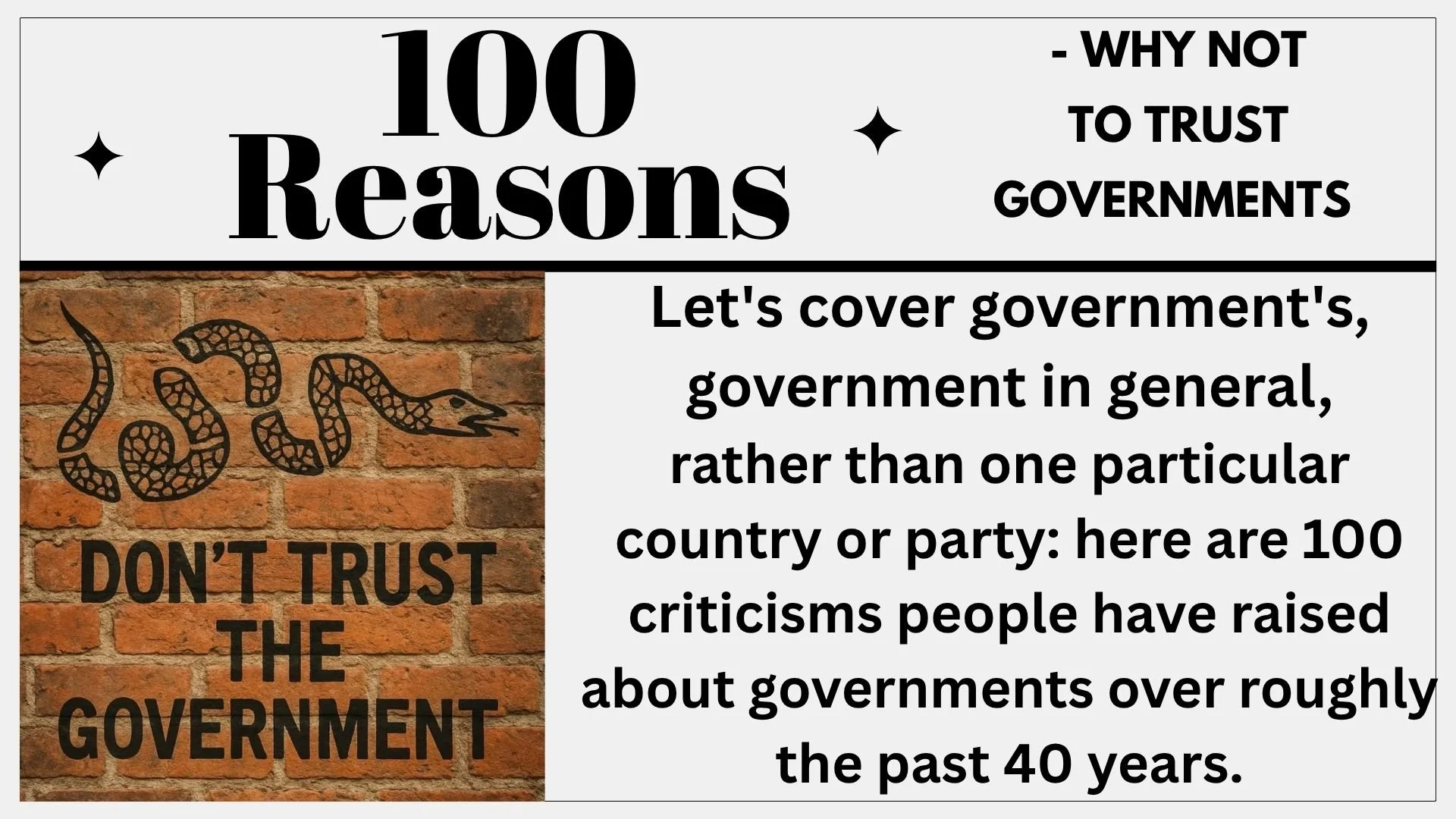
LETS GO,
1. Governments can concentrate too much power in too few hands.
2. Officials may use public office for personal or political gain.
3. Corruption can divert public money from essential services.
4. Lobbyists and wealthy donors can exert disproportionate influence.
5. Political decisions may favor powerful industries over the public.
6. Governments can make promises they cannot or will not keep.
7. Short election cycles can reward quick wins over lasting solutions.
8. Partisan conflict can prevent practical compromise.
9. Political polarization can make governing less effective.
10. Election campaigns can spread misleading claims.
11. Public agencies can become excessively bureaucratic.
12. Rules can be needlessly complicated or inconsistent.
13. Licensing requirements can make it harder to start a business or work.
14. Regulations can impose costly burdens on small organizations.
15. Government programs can be poorly designed or evaluated.
16. Agencies may continue ineffective programs because they are difficult to end.
17. Public spending can be wasteful or inadequately monitored.
18. Large projects can run over budget and behind schedule.
19. Procurement contracts can lack transparency.
20. Governments may hide mistakes rather than learn from them.
21. Public records can be difficult to access.
22. Officials may restrict information in the name of security or convenience.
23. Surveillance powers can threaten privacy.
24. Data collected for one purpose can be used for another.
25. Security systems can disproportionately target particular communities.
26. Emergency powers can outlast the emergencies that justified them.
27. Governments may restrict protest or assembly.
28. Police misconduct can go unpunished.
29. Excessive force can harm civilians and weaken public trust.
30. The criminal justice system can treat people unequally.
31. Mandatory sentencing can produce unjust outcomes.
32. Mass incarceration can damage families and communities.
33. Prisons may fail to rehabilitate people.
34. Criminal records can create long-lasting barriers to employment and housing.
35. Governments can censor speech or pressure media organizations.
36. Political leaders may attack independent journalism.
37. State propaganda can distort public debate.
38. Disinformation campaigns can exploit public institutions.
39. Governments may interfere with academic or scientific independence.
40. Political appointments can weaken expert agencies.
41. Policy can ignore scientific evidence.
42. Public-health decisions can be inconsistent or poorly communicated.
43. Health systems may be inaccessible despite substantial public spending.
44. Governments can mishandle disease outbreaks.
45. Public contracts for health services can create conflicts of interest.
46. Education policy can change too often to assess properly.
47. Schools can be burdened by administrative mandates.
48. Public education can reproduce regional or economic inequality.
49. Housing policy can restrict construction and worsen shortages.
50. Zoning rules can exclude lower-income residents.
51. Infrastructure can be neglected until failures become costly.
52. Public transit decisions can leave communities underserved.
53. Government energy policy can be unstable or contradictory.
54. Subsidies can protect established industries from competition.
55. Environmental rules can be weak, delayed, or selectively enforced.
56. Governments can fail to prepare for climate-related risks.
57. Public lands and resources can be mismanaged.
58. Disaster responses can be slow or unequal.
59. Immigration systems can be confusing, slow, or inhumane.
60. Border enforcement can violate rights or separate families.
61. Refugee policies may fail to protect people in danger.
62. Tax systems can be complex and difficult to navigate.
63. Tax burdens may fall unfairly across income groups.
64. Public debt can shift costs onto future generations.
65. Monetary and fiscal choices can contribute to inflation or instability.
66. Pension promises may be financially unsustainable.
67. Welfare programs can impose intrusive or humiliating conditions.
68. Benefits can be difficult to access even for eligible people.
69. Government aid can create dependency if poorly designed.
70. Public benefits can exclude people who need help.
71. Trade policies can harm workers in particular regions or industries.
72. Bailouts can socialize losses while leaving profits private.
73. Government-backed monopolies can limit consumer choice.
74. Public enterprises can lack competitive pressure to improve.
75. Regulations can be written or enforced unevenly.
76. Compliance costs can favor large companies over small competitors.
77. Governments may protect favored businesses from accountability.
78. Public-sector unions or interest groups can resist necessary reforms.
79. Privatization can transfer public assets without adequate safeguards.
80. Public-private partnerships can obscure who is accountable.
81. Foreign policy can involve costly or prolonged military interventions.
82. Military spending can crowd out domestic priorities.
83. Arms sales can support abusive governments or conflicts.
84. Intelligence agencies may operate with insufficient oversight.
85. National-security claims can be used to avoid scrutiny.
86. Governments can break treaties or commitments.
87. Aid programs may serve strategic interests more than local needs.
88. International sanctions can harm civilians as well as leaders.
89. Federal or central authorities can override local preferences.
90. Local governments can also be captured by narrow interests.
91. Centralized policies may not fit local conditions.
92. Decentralized systems can create confusing differences in rights and services.
93. Governments can neglect rural or remote communities.
94. Urban policy can displace residents through redevelopment.
95. Indigenous rights and sovereignty can be disregarded.
96. Minority groups can face unequal treatment by public institutions.
97. People with disabilities may encounter inaccessible services and facilities.
98. Government failures can erode trust in democratic institutions.
99. Political leaders may avoid accountability when policies fail.
100. No government can fully represent everyone’s values or interests. Ever.